Une anatomie parfaitement adaptée au vol. Acrobatique et spectaculaire, son vol est un régal pour nos yeux. Mais comment fait-il ?
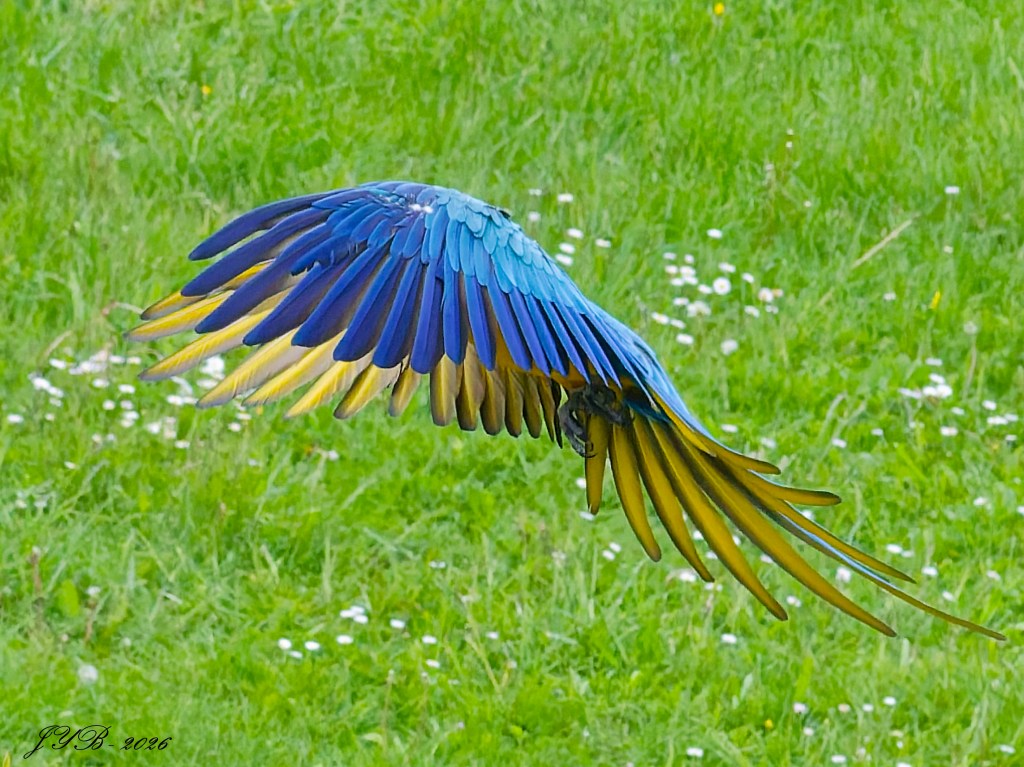
L’ara bleu – Ara ararauna – est un grand perroquet vivant dans les forêts inondables ou dans les forêts-galeries en Amazonie.
Sa grande taille (près de 90 cm (y compris les plumes caudales) n’est pas du tout un handicap en matière de vol. Son envergure peut dépasser les 110 cm.
Oiseau bruyant et grégaire, il est facile à voir et, surtout, à entendre. Ses acrobaties démontrent une certaine aptitude à la maîtrise du vol.
Pour cela, son anatomie est parfaitement adaptée.
Un équilibre du corps qu’un gros et lourd bec facilite en contrebalançant le poids des plumes caudales et du reste du corps.
Les ailes sont puissantes, larges et longues. Elles permettent la portance d’un oiseau dont le poids peut dépasser le kilo. Ses plumes effilées sont de nature à encore améliorer le vol.
Pour entreprendre ses manœuvres, décoller ou, tout simplement, battre des ailes, il lui faut une musculature puissante. Et pour cela, il a des muscles bien développés au niveau de ses pectoraux.
La stabilité en vol est assurée par les plumes caudales. Ses grandes plumes lui permettent d’effectuer en une fraction de seconde toutes les manœuvres. Comme ici, en phase d’atterrissage.
L’ara bleu en vol est un spectacle remarquable.
ENGLISH VERSION
The Blue-and-yellow Macaw – Ara ararauna – is a large parrot living in flood forests or gallery forests in the Amazon.
Its large size (nearly 90 cm (including tail feathers) is not at all a handicap when it comes to flying. Its wingspan can exceed 110 cm.
Noisy and gregarious bird, it is easy to see and, above all, to hear. Its acrobatics demonstrate a certain ability to master flight.
For this, its anatomy is perfectly adapted.
A balance of the body that a large and heavy bill facilitates by counterbalancing the weight of the caudal feathers and the rest of the body.
The wings are powerful, wide and long. They allow the lift of a bird whose weight can exceed one kilo. Its sharpered feathers are of a nature to further improve flight.
To undertake his acrobatic flight, take off or simply flap his wings, he needs a powerful musculature. And for that, he has well-developed muscles in his pectorals.
Flight stability is ensured by the tail feathers. Its large feathers allow it to perform all the aerial acrobatics in a fraction of a second. As here, in the landing phase.
The Blue-and-yellow Macaw in flight is a remarkable sight.
 Les photos de JYB
Laisser un commentaire