S’il appartient à cette grande famille, au même titre que les paons, perdrix et autres faisans, il a son propre genre. Un oiseau craintif qui fuit la présence humaine. Partons en Afrique découvrir le francolin à cou jaune.
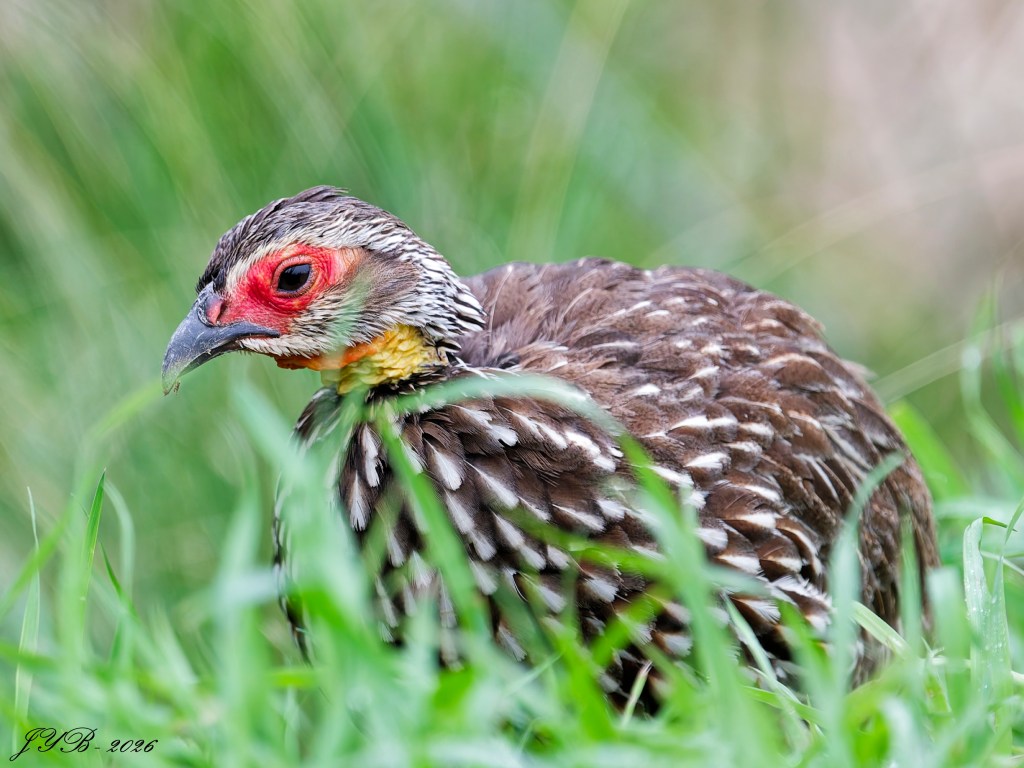
Le francolin à cou jaune – Pternistis leucoscepus – est originaire d’Afrique et plus particulièrement de la partie Est de ce continent. On peut ainsi l’observer au Kenya, en Ouganda, en Tanzanie, à Djibouti, au Sud-Soudan, en Érythrée, en Somalie, en Éthiopie et au Soudan.
Des pays plutôt semi-arides où poussent les acacias. Le francolin à cou jaune apprécie les terrains mêlant ce type d’arbres et une végétation pas trop haute. On le verra aussi dans les champs cultivés ou en lisière de forêt. À l’inverse, les zones aux pluies abondantes l’attirent également.
Finalement, le francolin à cou jaune démontre une certaine capacité d’adaptation à son environnement.
Dire que le francolin est un faisan est un peu exagéré. Il appartient bien à la famille des phasianidae qui comprend de nombreux genres comme les faisans, bien sûr, mais aussi les cailles, les perdrix, les paons, les pternitis (les francolins) et quelques autres.
Côté alimentation, c’est un peu comme tous les faisans. Des graines, des insectes et des végétaux.
L’essentiel est qu’il y ait des buissons à proximité. Il recherchera un abri sous ce couvert végétal en cas d’alerte. Si le danger est immédiat, il pourra s’envoler pour se poser un peu plus loin sur le sol ou sur une branche basse d’un arbuste.
Comme beaucoup de faisans, le francolin à cou jaune est une espèce chassable qui paie un lourd tribut.
Cette espèce semble s’éloigner des activités humaines. Si un champ semble prometteur pour la nourriture, il faudra que les humains ne soient pas trop présents. C’est donc une espèce que l’on ne verra pas trop en périphérie des villes.
ENGLISH VERSION
The Yellow-necked Spurfowl – Pternistis leucoscepus – is native to Africa and more particularly to the eastern part of this continent. In particular in Kenya, Uganda, Tanzania, Djibouti, South Sudan; Eritrea, Somalia, Ethiopia and Sudan.
Rather semi-arid countries where acacia trees grow. The Yellow-necked Spurfowl likes fields that combine this type of tree with vegetation that is not too tall. It will also be seen in cultivated fields or on the edge of forests. Conversely, areas with heavy rainfall also attract it.
Finally, the Yellow-necked Spurfowl shows a certain ability to adapt to its environment.
Saying that the spurfowl is a pheasant is a bit of an exaggeration. It belongs to the phasianidae family, which includes many genera such as pheasants, of course, but also quail, partridge, peacock, pternitis (spurfowl), and a few others.
On the food side, it’s a bit like all pheasants. Seeds, insects, and plants.
The main thing is that there are bushes nearby. He will look for shelter under this plant cover in case of an alert. If the danger is immediate, it can fly away to land a little further on the ground or on a low branch of a shrub.
Like many pheasants, the Yellow-necked Spurfowl is a huntable species that pays a heavy tribe.
This species seems to be moving away from human activities. If a field looks promising for food, humans must not be too present. It is therefore a species that will not be seen too much on the outskirts of cities.
 Les photos de JYB
Laisser un commentaire