Ils se ressemblent beaucoup. Ils ont été pendant très longtemps de la même famille. Mais il y a quand même quelques différences tant dans le comportement que dans les apparences. Découvrons un diamant mandarin beaucoup plus rare. Celui-ci nous vient d’Indonésie.
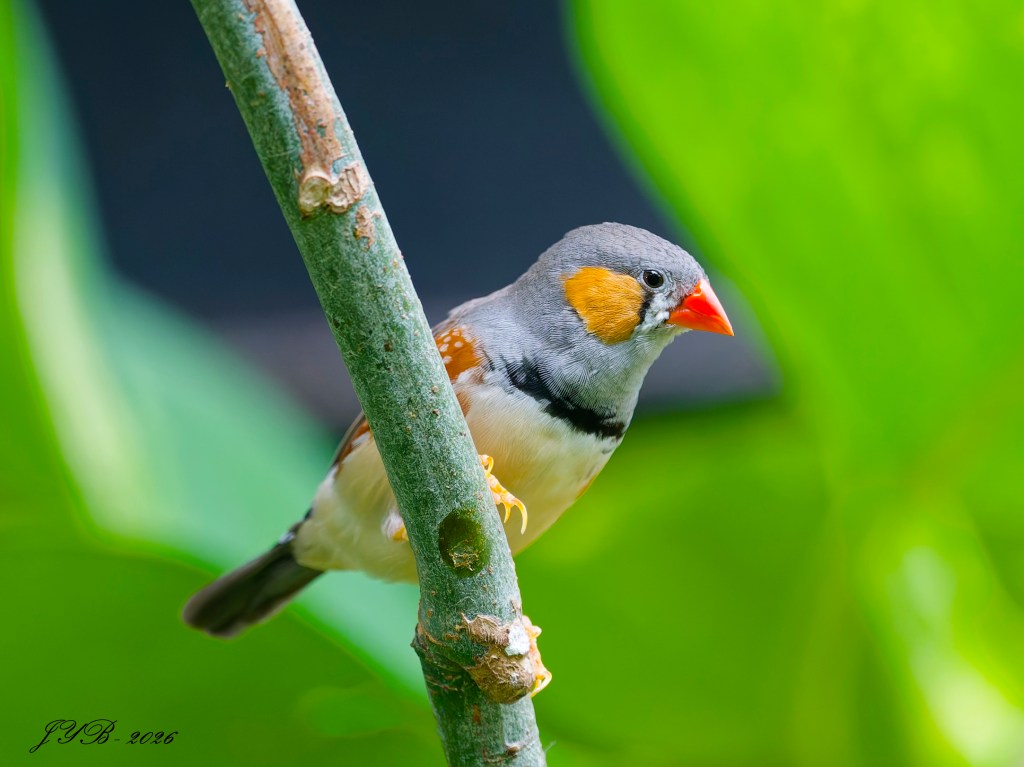
Le diamant de Timor – Taeniopygia guttata – est beaucoup moins connu que le mandarin d’Australie – Taeniopygia castanotis. Le diamant mandarin de Timor s’appelle désormais « Diamant mandarin »
Et pourtant, il a été découvert bien avant son cousin australien. Le diamant de Timor a été identifié en 1817 par Louis Jean Pierre Vieillot, ornithologue français bien connu. C’était 1837 pour le diamant mandarin australien par John Gould, ornithologue anglais.
C’est la raison pour laquelle le diamant mandarin australien, appelé aujourd’hui « Mandarin d’Australie » a été pendant longtemps considéré comme une sous-espèce du diamant de Timor. Maintenant, il s’agit d’espèces distinctes.
Donc, des changements de nom qui peuvent déstabiliser les amateurs.
Le diamant de Timor est plus petit. Il se reconnaît surtout à l’absence de stries sur la poitrine et la barre noire séparant le gris de la tête et de la gorge du plumage blanc crème du ventre est plus fine. Il est plutôt d’allure filiforme.
Il vit en Indonésie, sur les îles de la Sonde. On le trouve notamment à Lombok, sur l’île de Komodo et, bien sûr, à Timor.
Le mandarin d’Australie ne vit qu’en Australie. Il a tendance à être un peu plus rondelet.
Le diamant de Timor est craintif et s’avère souvent fragile. Il remue beaucoup mais se montre moins agressif que le diamant mandarin australien. C’est un oiseau grégaire et cette façon de vivre est vitale pour lui. C’est aussi pour cela que le diamant mandarin de Timor communique beaucoup avec ses semblables. Il émet alors des cris ou chante très souvent. Le chant est typique des mâles puisque les femelles ne chantent pas. Mais il a le cœur fragile. Le stress peut lui être fatal.
ENGLISH VERSION
The Timor Zebra Finch – Taeniopygia guttata – is far less well-known than the Australian Zebra Finch – Taeniopygia castanotis -. The Timor Zebra Finch is now simply referred to as the « Zebra Finch. »
Yet, it was discovered long before its Australian cousin. The Timor Zebra Finch was identified in 1817 by Louis Jean Pierre Vieillot, a renowned French ornithologist, whereas the Australian Zebra Finch was identified in 1837 by John Gould, an English ornithologist.
For this reason, the Australian Zebra Finch was long considered a subspecies of the Timor Zebra Finch; today, however, they are recognized as distinct species.
So, name changes that can be confusing for enthusiasts.
The Timor Zebra Finch is smaller. It is distinguished primarily by the absence of streaks on the breast, and the black bar separating the grey of the head and throat from the creamy-white plumage of the belly is narrower. It has a rather slender, elongated appearance.
It lives in Indonesia, in the Sunda Islands. It is found notably on Lombok, Komodo Island, and, of course, Timor.
The Australian Zebra Finch lives only in Australia. It tends to be a bit plumper.
The Timor Zebra Finch is timid and often proves to be delicate. It is very active but less aggressive than the Australian Zebra Finch. It is a gregarious bird, and this social lifestyle is vital to its well-being. Consequently, the Timor Zebra Finch communicates frequently with others of its kind, often calling or singing. Singing is characteristic of the males, as the females do not sing. However, it has a delicate constitution; stress can be fatal.


Votre commentaire