ARTICLES
Derniers articles
- LE NACRÉ PORPHYRIN, UN PAPILLON DES MONTAGNES – THE TITANIA’S FRITILLARY, A MOUNTAIN BUTTERFLY.
- COULEURS D’AUTOMNE.
- L’AIGLE HUPPÉ A UNE PETITE HUPPE – CHANGEABLE HAWK-EAGLE
- LA MÉSANGE CHARBONNIÈRE IMPOSE SA LOI – GREAT TIT.
- LE PINSON DES ARBRES : UN PLUMAGE TRISTOUNET – CHAFFINCH.
LE NACRÉ PORPHYRIN, UN PAPILLON DES MONTAGNES – THE TITANIA’S FRITILLARY, A MOUNTAIN BUTTERFLY.
Un joli papillon que l’on peut observer pendant les mois d’été et à condition d’être en montagne. Les prairies humides et les clairières sont les endroits propices à cette rencontre.
Si vous voyez des violettes ou des renouées, peut-être le verrez-vous ?
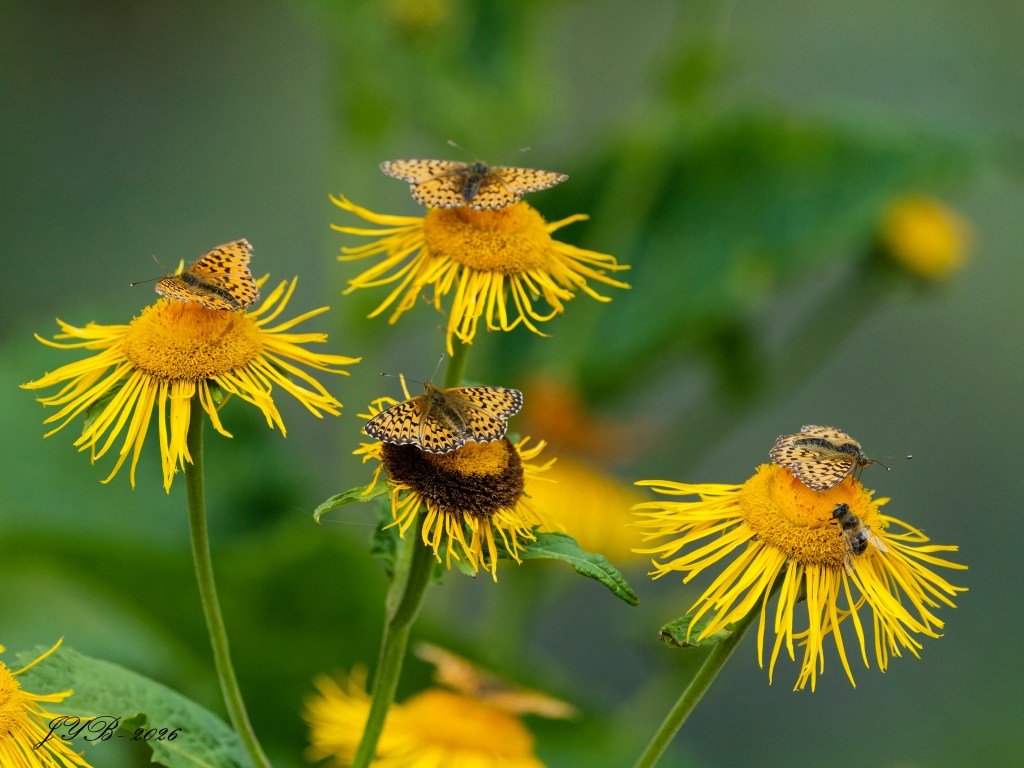
Le Nacré porphyrin – Boloria titania – est un papillon que l’on trouve en montagne mais pas partout.
Dans l’arc alpin, sa présence est localisée et sporadique. Nous pouvons l’observer jusqu’à 2300 mètres d’altitude. Nous étions à 1700 mètres d’altitude dans le Val d’Aoste en Italie quand nous avons photographié ces papillons.
Nous étions alors en juillet, période où nous avons le plus de chance de l’observer. Il faut en profiter la période pour le voir s’étale de juin à août.
Il est présent en Auvergne et dans quels autres massifs montagneux mais au-dessus de 800 mètres d’altitude. En dehors de la France, il est originaire d’Eurasie (de l’Europe centrale à la Sibérie).
Il est d’ailleurs posé sur une plante appelée « œil de bœuf » ou, plus scientifiquement, Télékie superbe – Telekia speciosa -, originaire d’Europe centrale et du Caucase.
Chez le nacré porphyrin, la femelle est plus grande que le mâle (48 mm vs 42 mm).
Ce joli papillon habite les prairies humides, les clairières, les lisières jusqu’à l’étage alpin.
ENGLISH VERSION
The Titania’s Fritillary – Boloria titania – is a butterfly found in mountainous regions, though not everywhere.
Across the Alps, its presence is localized and sporadic. It can be observed at altitudes of up to 2,300 meters. We were at an altitude of 1,700 meters in the Aosta Valley, Italy, when we photographed these butterflies.
It was July—the time of year when one is most likely to spot them. It is best to take advantage of this window, as the period during which they can be seen spans from June to August.
It is found in the Auvergne region—as well as in other mountain ranges—but only at altitudes above 800 meters. Outside of France, it is native to Eurasia (ranging from Central Europe to Siberia).
In fact, it is currently resting on a plant known as « heart-leaved oxeye »—or, more scientifically – Telekia speciosa – which is native to Central Europe and the Caucasus.
Among the Titania’s Fritillary, the female is larger than the male (48 mm compared to 42 mm).
This butterfly inhabits damp meadows, forest clearings, and woodland edges, reaching as high as the alpine zone.

COULEURS D’AUTOMNE.
La saison est remarquable par la diversité de ses couleurs. L’automne est une saison si particulière. Une certaine harmonie semble envahir la nature. Mais notre perception poétique n’est peut-être pas la même pour ces chardonnerets pour qui se nourrir est primordial avant l’arrivée de Monsieur Hiver.
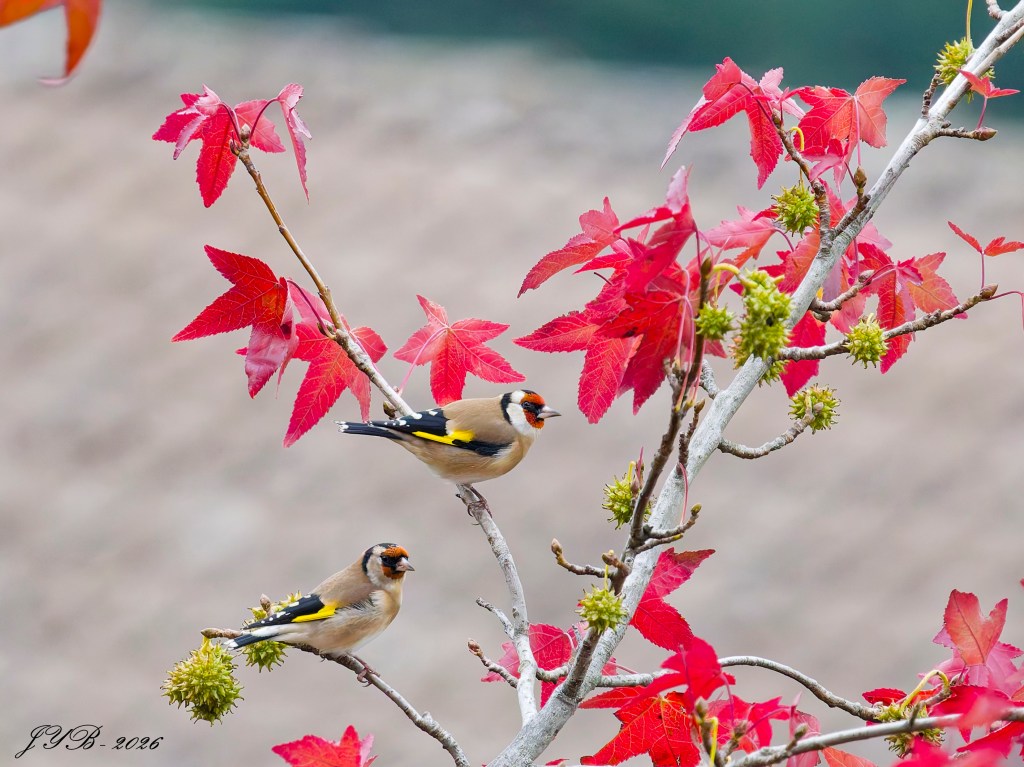
Les chardonnerets élégants semblent apprécier les graines de ce copalme d’Amérique.
Un moment furtif sous un rayon de soleil bienvenu.
Il parait que cet oiseau magnifique se fait rare. Alors quelle chance d’entendre son chant mélodieux et son plumage remarquable.
Et Il vient souvent accompagner d’une douzaine de congénères. Profitons du spectacle !
ENGLISH VERSION
European goldfinches seem to enjoy the seeds of this American sweetgum tree.
A fleeting moment, caught in a welcome ray of sunshine.
It is said that this magnificent bird is becoming rare—so what a stroke of luck to hear its melodious song and behold its striking plumage!
And it often arrives accompanied by a dozen or so of its kind. Let’s enjoy the spectacle!
L’AIGLE HUPPÉ A UNE PETITE HUPPE – CHANGEABLE HAWK-EAGLE
Il vit en Asie du Sud-Est et en Inde. Il passe une grande partie de son temps caché dans la végétation d’un arbre. Il attend patiemment, toujours sur le même perchoir, le corps bien dressé. Mais quand un bruit suspect se fait entendre ou qu’une situation particulière surgit, sa huppe se dresse sur la tête. La huppe de l’aigle huppé est un signe de stress ou d’inquiétude.
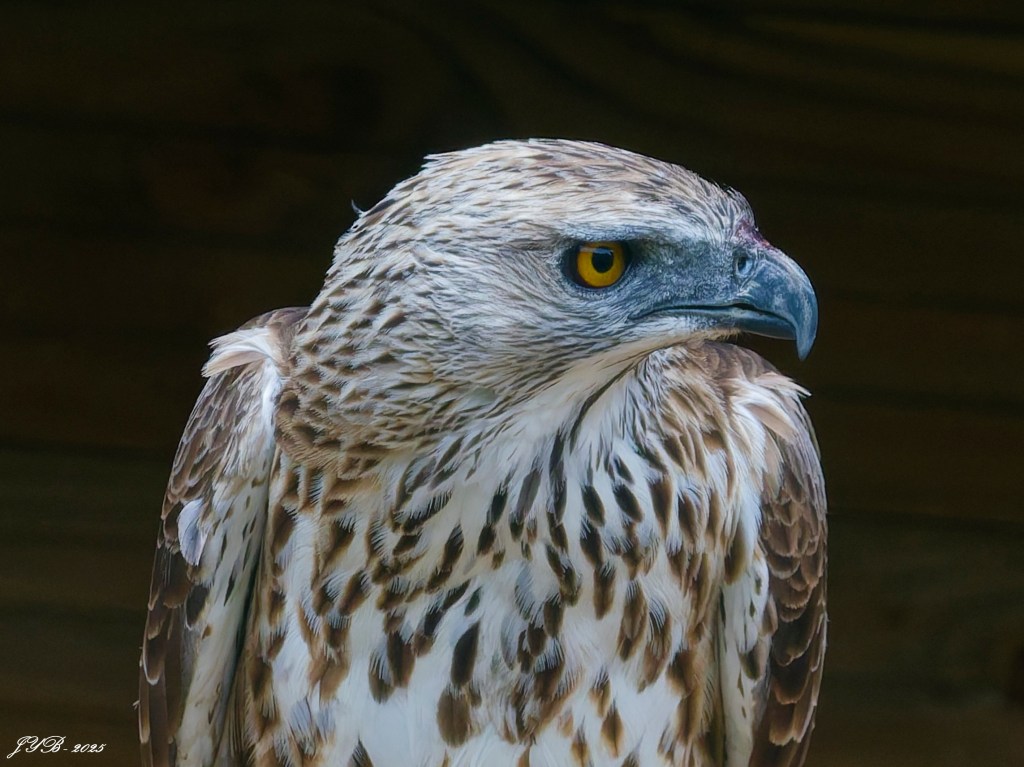
L’aigle huppé – Nisaetus cirrhatus – fait partie de ces aigles dotés d’une huppe érectile.
Mais, comme souvent, certaines espèces sont mieux fournies que d’autres. L’aigle huppé, quant à lui, a même la huppe la plus modeste du genre.
Cette huppe, si elle est plutôt discrète chez l’aigle huppé, se voit davantage quand ce rapace se sent menacé ou inquiet. Certaines sous-espèces n’ont quasiment pas de huppe voire pas du tout alors que chez d’autres, elle est bien visible.
A priori, il semble ici tranquille.
L’aigle huppé présente une grande diversité de couleurs et de taille. Ce qui lui a valu son nom anglais de « Changeable Hawk-Eagle ».
ENGLISH VERSION
The Changeable Hawk-Eagle – Nisaetus cirrhatus – is one of those eagles that possess an erectile crest.
However, as is often the case, some species are more « well-endowed » in this regard than others; the Changeable Hawk-Eagle actually has the most modest crest within its genus.
While the crest is rather inconspicuous in the Changeable Hawk-Eagle, it becomes more noticeable when the bird of prey feels threatened or uneasy. In some subspecies, the crest is barely present—or entirely absent—whereas in others, it is clearly visible.
In this instance, the bird appears to be calm.
The Changeable Hawk-Eagle exhibits a great diversity in both color and size—a characteristic that earned it its English name, « changeable hawk-eagle. »

